BAFS-Solution-2022-550x550h.jpg)

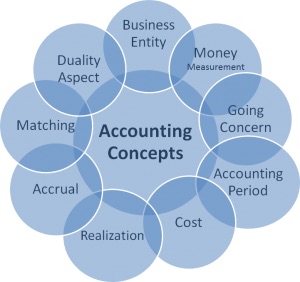


Looking for a BAFS tutor? Whether you are looking for primary school BAFS, secondary school BAFS, DSE BAFS, tertiary school BAFS, IGCSE BAFS, IB BAFS, accounting tutorials, corporate finance tutorials. HKTA GETUTOR can provide tutors for all of them.
Serving Hong Kong for 10 years, we have a large number of corporate finance instructors from different professions and academic qualifications for you to choose from. We can match your needs with the most suitable trainers.

Incumbent teacher 13 years teaching experience
I am a secondary school teacher on Hong Kong Island, Head of Section at BAFS, with about 13 years teaching experience. I can provide a lot of notes and questions in English and Chinese.
Tutoring students: DBS/St. Paul/Sacred Heart/Germany/Maryman/American International School/Singapore International School/Shatin Government Secondary School/HKU Alumni Association/Hong Kong Island People's Livelihood/Po Leung Kuk Lam Man Chan English Primary School

Full-time tutoring
I have completed a degree program in business administration at the Polytechnic University, and am now a full-time tutor. I have achieved 5** in the BAFS subject at this DSE.
I have more than ten years of tutoring experience for many middle school students in the BAFS subject (including students who have obtained 5** in the HKDSE examinations for many sessions), and I deeply understand the difficulties students encounter in their studies. I have a strong sense of responsibility and patience, so I can prepare my own notes and exercises. I hope you can give me a chance, thank you.

6+ years tutoring experience
\- Former Zunli and King's BAFS Tutorial Corporate Finance Tutor
– 8 years tutoring experience
– Graduated in Accounting and Finance of the University of Hong Kong
– BAFS 5**, AL Accounting A, AL Business Studies A
– Provides all packages (Notes, exercises, mock papers, past paper, book from heaven)
– One-to-one/group available

7+ years tutoring experience
I graduated from Wah Yan College in Hong Kong and am currently studying in the third year of the Department of Journalism and Communication of the Chinese University of China. Got the best 5 29 points in DSE,
Where BAFS(accounting)5**.
I have more than 3 years of experience in tutoring S6 DSE candidates for 3 consecutive years, and all students (8 of them) have been successfully promoted to 2 grades within 3 months, and 4 of them have even obtained 5or above.
I understand the insufficiency of day school teachers and the problems faced by students. I will share my answering methods and experience, and I will be able to recover all the topics in a short period of time.
There are notes and questions for practice, and will provide the method and timetable for the practice of the paper. You can also whatsapp to ask the book at any time to meet the needs of the students.

More than 2 years of supplementary BAFS experience
I am a first-year student of Bachelor of Finance (Asset Management and Private Banking) at the University of Hong Kong. I have studied at Marymount Secondary School, a traditional famous school.
dse is the best 5 31 and has been awarded the HKU Admission Scholarship. bafs 5**
I got 8.5/9 in IELTS IELTS reading and listening. I have been conditionally admitted to a top British school and have tutoring experience for primary and secondary school students. I will prepare notes and practice for students in each class. I hope that students can master the course in a short time and enjoy learning. pleasure

2+ years tutoring experience
I am a graduate of Band 1 Girls' School and am currently studying in HKUST BBA IS year 2. I got 28 points in the public examination in 2020, of which I got 5** in mathematics and 5* in BAFS.
I have two years of tutoring experience. I will provide personal notes for students to review, as well as test questions for students to apply what they have learned. Before the students take the test, a mock test paper will be provided to help students practice the speed of answering and familiarize themselves with the test mode.
As I am a recent graduate, I can master the questioning methods and answering skills of the HKEAA, and I can pass on my personal experience to high school students. I hope the students can use clever skills to shorten the time for answering questions without losing points.
Although I am only a college student and do not have extensive tutoring experience, I still use my spare time to make notes, understand students' weaknesses and improve them, hoping to achieve good results for students.




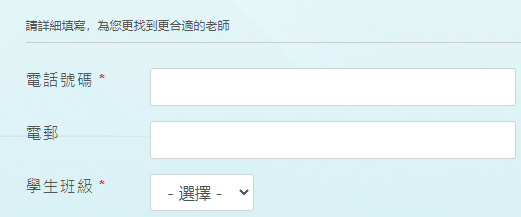
You need to fill in your case information and your requirements for the tutor.

We will recommend 3-5 suitable GCSE A-Level IGCSE tutors by providing their resumes, GCSE A-Level IGCSE teaching experience ,and other related information. It will take one working days to process your application normally.


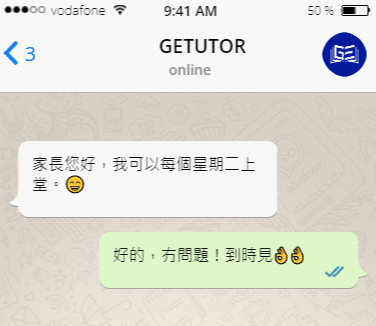
We will coordinate the time and arrange to start classes.
Let's hear from our customer Nicole, 2022 IGCSE candidate

To help you excel in the BAFS Enterprise Finance DSE and exams, GETUTOR got some advice and strategies from the star tutor - SIR Lim.
Paper 1 tests candidates' knowledge of the compulsory parts of the BAFS Corporate Finance programme. the two main parts of the BAFS Exam Corporate Finance Exam:
Most short questions are usually situational questions and students will often lose points for not answering the question in detail and clearly. Especially when they deal with "Introduction to management"and"personal financeThis is especially common when dealing with module-related issues.
For example: students were asked to explain the consequences of HSBC stopping paying dividends. It is not enough that "the stock price will fall". To receive full credit, they must demonstrate their entire process of deductive reasoning. In other words, they should start by pointing out that such behavior would make HSBC shares less attractive to its shareholders, causing some of them to sell their shares. The addition of suppliers will cause its stock price to fall. And, he reminded students to tailor their explanations to the given scenario.
“Be precise and specific when writing and avoid using generic words in your answers.”
Take the advantages of division of labor adopted by clothing manufacturing companies as an example. Rather than separation and specialization of work tasks “impacting” productivity, students should make it clear that it “increases” productivity. At the same time, it is crucial to choose your words carefully. "Don't forget the terminology and theory you learned. They're what separate you from candidates who didn't review."
SIR Lin's advice is to read through all the questions in the exam paper before attempting to answer them.
"There is no need to answer the 'required' questions in order," he said. "Start with the ones you are most confident in answering. Then, work on more challenging questions. This will make your exam go more smoothly."
Some candidates answer both questions in Section B Part 2, even though only the higher-scoring answer counts towards the final grade.
When dealing with MC questions, most students are only concerned with getting the correct answer and use exclusion for questions they don't know the answer to. While this saves time, he encourages using the time spent on past papers to consider why other options are incorrect.
Many times, the Hong Kong Examinations and Assessment Authority will modify the questions from previous years' examinations and reuse them. What might have been the right answer in the past may be wrong this time. Candidates should be careful about these trick questions.
Sir advises candidates opting for accounting or management modules as electives to set your target to complete the MC questions in not more than 35 minutes and 45 minutes respectively. Please make sure to complete all MC questions before moving on to short questions as each MC question is worth two points.
Continuing with Paper 2A, GETUTOR tutors are urging accounting students to not only focus on practicing their calculation skills but also to prepare for the highly predictable explanation questions as these short questions can deliver 10 out of 80 marks.
If you don’t have enough review time, please prioritize studying the concepts and topics that appear most frequently in past exam questions:
Books for accruals and advance payments; allowance for doubtful accounts; original entries and measures and depreciation. These are likely to appear in sub-problems of a larger problem that deals with highly challenging topics such as correcting errors and incomplete records.
If you are a management student studying Paper 2B, it is best to complete the case study questions in Part B first and then return to the short questions in Part A. Please do not write long answers to short questions.
Welcome to this accounting channel! We will teach you the most basic concepts of double-entry accounting in just 3 minutes, helping beginners and DSE candidates better understand this important accounting topic. Let's explore the logic behind double-entry accounting and master this essential skill through practical examples.
New accountants often feel confused when learning basic accounting concepts. Accounting jargon can often be difficult to understand in schools or online courses, especially when the concepts are taught in someone other than your native language. This dilemma not only affects learning efficiency, but may also lead to a gradual fading of interest in accounting.
Double-entry accounting is one of the most basic and important concepts in accounting records. It involves that every transaction must be recorded on both the debit and credit sides to keep the accounts balanced. This method can not only accurately reflect the financial status of the company, but also help the company conduct effective financial analysis.
Double-entry accounting mainly consists of two parts: debit (Debit) and credit (Credit). A debit is used to record a transaction that increases an asset or decreases a liability, while a credit is used to record a transaction that decreases an asset or increases a liability.
To master double-entry accounting, you first need to understand the logic behind it: every transaction affects the financial status of the business, and this impact needs to be reflected in both debits and credits. This approach helps ensure the accuracy and completeness of the accounts.
In double-entry accounting, a debit represents an increase in an asset or expense, while a credit represents an increase in a liability, capital, or income. Understanding this is the key to mastering double-entry accounting.
The concept of double-entry accounting can be easier to understand by applying it to daily life. For example, when you borrow money from a friend, your cash (asset) increases, and your liability (the money you need to pay back to your friend) also increases.
When a company borrows money from a bank, how the transaction is reflected in double-entry accounting is key. Through a simple example, we can clearly see how double-entry accounting works.
Take the company's loan of $100 from the bank as an example. The way this transaction is recorded in double-entry accounting is very intuitive. A debit of Cash $100 reflects the increase in the company's assets, while a credit of Bank Loan $100 reflects the increase in the company's liabilities.
Another example in day-to-day business activities is paying your water bill. This process shows how double-entry accounting handles a company's expense payments.
When the company pays water bill $200 in cash, the payment is recorded as a debit to water bill $200 and a credit to cash $200 to reflect the reduction in cash assets.
Through these practical examples, we can see that double-entry accounting is not only the basis of accounting records, but also an indispensable tool for understanding a company's financial status. From examples of loans to paying water bills, we learned how to properly record different types of transactions.
After mastering the basics of double-entry accounting, the next step is to learn how to apply this knowledge to perform more complex financial analysis and decision-making. With the accumulation of practical experience, accounting learners will be able to develop a deeper understanding of all aspects of business finance.
FAQ
Tutors provide private tutoring and professional assistance to meet the test study needs of your students and parents. Grades will improve, thinking will be sharper, and learning will be more efficient, but more importantly, his/her self-confidence and abilities will increase.
Other benefits include:
Anyone can consult or use a BAFS tutor if you need one. Not only the recommended BAFS tutors, but also other registered tutors on the platform are very popular.
Demanders such as:
Each student has a different learning style and absorption rate, preferred learning style, strengths and interests are also different, so in one-to-one BAFS tutoring, this specific tutor can focus on teaching a student, tailor-made courses, answers and advice specifically for individual corporate finance students, together to achieve his/her learning goals.
GETUTOR is confident to say that having served Hong Kong students for 10 years, we have the absolute experience and ability to match students' academic needs and learning styles with the right corporate financial advisors.
GETUTOR has 140,000 professional BAFS tutors and a trustworthy team of tutors who can cater to students with different needs and abilities. The tutors all join because they want to be excellent educators and contributors to a better society, but equally important is their love for teaching. As the saying goes, it takes ten years to grow trees and a hundred years to cultivate people. Education is the foundation of the future and the foundation of the world. Fundamentally, only by teaching students well can we have a better world.
At the same time, GETUTOR is committed to providing flexibility and high-quality education with its professional approach, which makes it stand out among similar tutoring agencies and was awarded the 2024 Best Tutoring Matching Platform in Hong Kong.
If you decide to go with GETUTOR, we can discuss your student's level of study, goals, areas of strengths and weaknesses, learning styles and ideal BAFS tutors and teaching styles, and then we will match your student with the most suitable Enterprise Finance tutor.
Interested parents and students please click directlyRegister for tutoring here.
Tutor fees depend on the tutor's teaching experience, the student's level of study and subject area. Once we have identified a suitable BAFS tutor and class schedule, we will proactively contact you with the contact information and background of the BAFS tutor. The whole process usually takes only a few hours.
Most of the students and the Enterprise Finance tutors will have 1.5 to 2 hours of tutorials. For one thing, it is better for both parties in terms of travelling and scheduling; for another, the students can learn more in-depth and at the same time, it is not too much work for them.
This depends on the student's current level, what they want to improve on, and their schedule. Most students schedule 2-3 sessions of financial tutoring, but progress can be seen in each weekly session.
It also depends on the student. The results of BAFS tutoring will come over time and with the effort of the student - on average, significant progress is noticed after 3 months. One of the main goals of Enterprise Finance Tutoring is to provide students with the tools to succeed. Developing talent and learning takes time, but once learned, these habits will have a positive impact on the student's entire academic career.
Generally, the Enterprise Finance tutorials will be conducted at the student's home. If this is not convenient, then online tutorials such as ZOOM can be used. When using ZOOM at home, students feel comfortable and relaxed, and in a familiar environment, the mind is more calm and clear, and therefore more open and receptive to BAFS tutorials and learning.
The BAFS tutoring programme between students and Enterprise Finance tutors has been created entirely to meet the needs of students. If the student needs extra practice, you can ask the tutor to arrange extra homework. However, it is important to note that homework is for consolidation of learning and deepening of understanding, not the more the better.
We generally recommend that tutors liaise with parents. Enterprise Finance tutors can inform parents about their student's progress and alert you to areas where your student may need additional help. The three-way co-operation between parents, tutors and teachers is the cornerstone of achieving your student's desired goals.
If you are a parent please:
Now repost from the button below the blog to the GETUTOR website, "Contact the staff to get a $20 tuition fee waiver, without further ado, go and search for a suitable tutor to take classes now

Want to catch up on school progress?GETUTOR Hong Kong Tutor AssociationThere are more than 35,000 three tutors
Find the best tutor for you in as little as one hour!



[30 minutes instant pairing]Provide a large number of high-quality door-to-door private tutors for you to choose from, and there is no introduction fee for parent-student pairing.
Hotline: 63080831
Hong Kong's largest tutoring agency
【Government certification company】


馬上為您安排 __ 的老師
請填寫簡單資料讓我們為你聯絡__導師