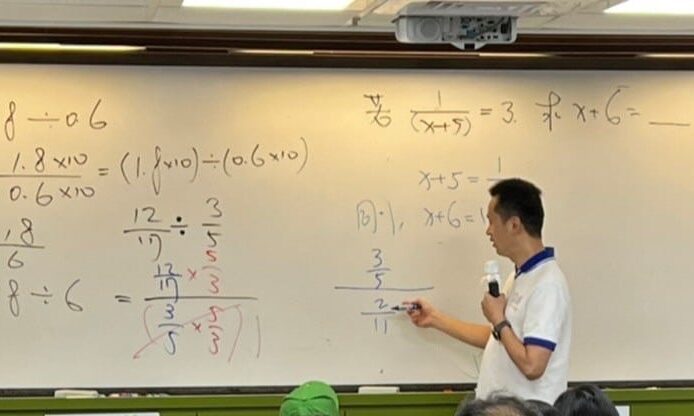
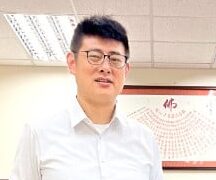
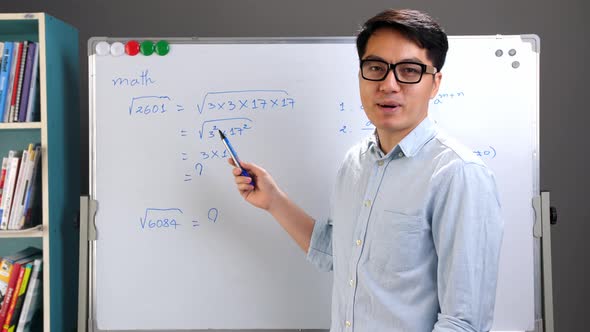
Lessons are carefully tailor-made to suit various students with different learning styles. I do not waste student's time and will place heavy emphasis on the learning curriculum and exam success.
I am the youngest in my year to receive university offers as I was give an opportunity to skip 2 grades. My profile is as below:
Year 1-Year 9 – studied in an international school in Hong Kong
Year 12 & 13 – studied in one of the top performing high school (OIC) in UK after I achieved 3 其他學制 A* and 8.5 IELTS results. My 其他學制 predicted grade in Maths, Pure Maths, Physics and Chemistry is A* for each subject.
I got conditional offer for Mathematics from three top universities in UK and conditional offer for Quantitative Finance in CUHK and HKUST.
I have 2 years of tutoring experience teaching Maths, Physics and Chemistry. All the students I taught had a massive improvement in their grades.
精選客人評論
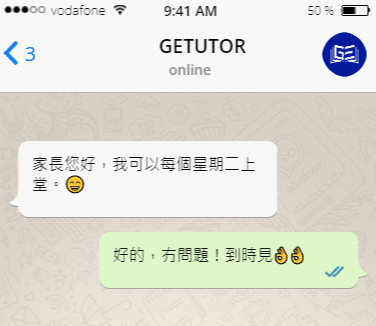
個仔讀緊 其他學制 Math (AA HL),底子好差,尤其係 Calculus 嗰課跟得好辛苦。搵到呢位老師真係好好彩,佢對其他學制課程好熟,一兩堂就睇得出個仔邊啲概念未清,即刻針對性俾練習。佢啲筆記好精要,覆message又快,好有交帶。
Language serves as the fundamental medium for human communication, enabling the expression of ideas, emotions, and cultural identity across societies. Structurally complex yet universally access其他學制le, it encompasses syntax, semantics, phonetics, and morphology—systems that govern meaning and sound. Over 7,000 languages exist globally, each reflecting unique historical, social, and cognitive frameworks. Beyond mere information exchange, language facilitates social cohesion, education, and innovation, while preserving intang其他學制le heritage. Its acquisition occurs through innate biological predispositions and environmental interaction, demonstrating remarkable neuroplasticity in early development. Linguists study language evolution, noting influences from technology, migration, and globalization that drive lexical changes and dialect convergence. As both a cognitive tool and cultural artifact, language remains indispensable for human progress, underscoring the need for preservation efforts amid declining linguistic diversity worldwide.
A specific topic forms the essential foundation for coherent communication and focused exploration. Without a clearly defined subject, any attempt toconvey information, present an argument, or facilitate meaningful discussion becomes inherently challenging and potentially ineffective. Theabsence of a central theme leaves the content directionless, lacking the necessary context for the audience to engage meaningfully or for the writer tostructure their thoughts logically. Whether in academic writing, professional reports, or casual conversation, a well-defined topic providescrucial boundaries and objectives. It guides research, shapes the narrative flow, and ensures that all presented information remains relevant andpurposeful. Ultimately, the clarity and impact of any message are significantly diminished when its core subject remains unidentified or ambiguous,hindering both understanding and productive exchange. Defining the topic is the indispensable first step towards effective communication.
Language serves as the fundamental infrastructure for human cognition, communication, and cultural continuity. It is a complex, rule-governed systemof symbols – sounds, gestures, or written characters – that enables individuals to encode thoughts, convey information,express emotions, and negotiate social relationships. Beyond mere transmission of ideas, language shapes perception and thought processes,influencing how individuals categorize and understand their experiences. It facilitates the accumulation and transmission of knowledge acrossgenerations, forming the bedrock of education, science, literature, and social organization. Its dynamic nature constantly evolves through usage,reflecting societal changes and enabling adaptation. Mastery of language, encompassing grammar, vocabulary, pragmatics, and context, is thereforeessential for effective participation in all facets of personal, professional, and civic life.
The period, often referred to as a “dot” or “full stop,” is a fundamental punctuation mark with surprisingly broad significance across various domains. Grammatically, its primary function is unambiguous: it terminates declarative sentences and commands, providing essential clarity and rhythm to written language. This simple mark prevents confusion by separating distinct thoughts, allowing complex ideas to be conveyed sequentially. Beyond syntax, the dot holds symbolic weight. Visually minimal, it represents finality, completion, or a focal point. In mathematics and science, a single dot denotes multiplication or acts as a decimal separator, critically influencing numerical interpretation and calculation precision. The advent of digital technology exponentially amplified the dot’s importance. It serves as the crucial delimiter in domain names (e.g., “example.com”), distinguishing the domain from its top-level suffix and enabling the structured navigation of the internet. File extensions (.doc, .jpg) rely entirely on the dot to signal format and associated applications to operating systems. In computing paths and network addresses, dots delineate hierarchical structures and specific locations within vast digital landscapes. Furthermore, in graphical user interfaces, the dot frequently appears in icons, loading indicators, and selection markers, contr其他學制uting to intuitive user interaction. Its role in abbreviations (e.g., “e.g.”, “i.e.”), while sometimes optional, aids conciseness. Despite its diminutive size, the period’s absence or misuse can lead to significant misunderstandings, grammatical errors, or technical failures. It is a cornerstone of written communication, a critical component of digital infrastructure, and a versatile symbol of precision and conclusion. The ubiquitous dot, therefore, transcends its humble appearance, functioning as an indispensable tool for organization, clarity, and meaning across linguistic, symbolic, and technological contexts, demonstrating that profound utility can reside within the most minimal form.
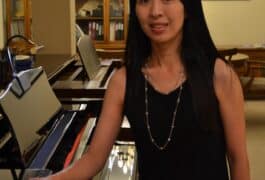
Miss F(按導師私隱要求使用化名,導師資歷已獲 GETUTOR 平台認證)— 香港中文大學數學系畢業(主修 Pure Math),DSE 數學 5** / M2 Level 5**。畢業後喺馬鞍山一間補習社做兼職四年,2023 年起全職私補。主力補馬鞍山及沙田區 Band 1 英中嘅中三至中六數學。教學年資 5 年,累計教過超過 48 個 DSE 數學學生,當中 17 個最終攞 Level 5 以上。教學風格偏向「圖形先行,代數後上」。
Miss F 指出:「好多學生聽到 Quadratic Functions 就死咗喺 y = ax² + bx + c 呢條公式,背到識。但考試唔係齋問你代入,會問你『呢條拋物線幾時最大?為咗咩角度會變?』你唔識睇圖就點都答唔到。我教每一條 quadratic 題都先畫個 graph,標 vertex、axis of symmetry、roots 喺邊,再談代數。」
佢嘅獨家教學法係「拋物線三標法」— 任何 quadratic 題都先標三樣嘢:頂點(vertex)、對稱軸(axis of symmetry)、根(roots 或 y-intercept)。呢個框架可以對付 90% 以上嘅 Paper 2 相關 MC,亦能解 Paper 1 嘅 structured 題。呢套喺大班教唔到,因為需要逐條題目逐步帶學生畫圖。